Nadine Kam photos
Black tiger prawns were torched and served in that perfect crunchy/sweet state between being sashimi and fully cooked.
BY NADINE KAM
Sushi Murayama is one of the few restaurants lately, to open as an instant hit, thanks to chef/owner Ryuji Murayama’s sterling reputation at Tokkuri-Tei. His first solo restaurant is therefore packed, so don’t expect to get a reservation right away.
The biggest draw may very well be the chef himself. Born in Japan and raised here since 3, he’s more local than Japanese so you don’t have to worry about any language barriers. He spent three-and-a-half years honing his sushi skills in Japan, but in another life, he could have been a comedian as he keeps jokes coming, while welcoming each guest as a long-time friend.
In the age of the celebrity chef, he brings the one thing to the table that others have forgotten in recent years, hospitality. He leaves guests feeling good, and that positive vibe carries over to the entire experience.
Chef Murayama presents the prawns at the sushi counter.
The restaurant has a decent sized izakaya menu, but it’s the sushi that stands out, and the chef’s $75 per person omakase menu is a good place to start for those game to try anything. At any rate, it will lift you out of ahi mode to try many other types of fish.
Considering that, squeezing in between others’ reservations, I had an hour to complete this menu of chef’s selections, Murayama put out 10 selections at a rate of one selection about every 6 minutes. That’s some speedy work. The type and number of selections vary with availability of fish and shellfish, and perhaps your enthusiasm level. If you’re gushing over every dish, chef may just want to keep the praise coming.
Costwise, this broke down to $7.50 per selection. If you were to go the a la carte route for sushi, the range is $5 for tako, $8 for hamachi, ikura or scallop, up to $20 for ootoro and $27 for black tiger prawns.
The presentation is more fish market vendor than artisan, but few would complain about the huge slabs of fish Murayama layers over rice, including a generous cut of premium chutoro, the tuna’s fatty underbelly, the starting dish of the day’s omakase.
It was the opposite of my first experience with this chef and chutoro, ordered as sashimi. When he presented a plate with just a pinky finger size portion of fish, my friends and I were like, “What the …?” before realizing he was just toying with us.
The full-size serving chutoro sashimi, part of another dinner exploring the izakaya menu.
Next up on our omakase was hirame, or fluke, topped with crunchy engawa, or fluke fin, for extra texture. It isn’t often that engawa shows up on the table, so I felt very privileged. Murayama dusted the serving tray with snow-mimicking salt, a reminder that winter fish from Japan are at their most voluptuous state of fattiness, prompting us to try to get in as many visits as we can before warmer weather sets in. That little touch of salt was all this fish needed.
A perfect marriage of sake, or salmon, and ikura. Not a single morsel of the pearl-size roe went to waste.
Showing posts with label sashimi. Show all posts
Wednesday, January 20, 2016
Tuesday, January 27, 2015
First bite: Gokoku Sushi at Koko Marina
Nadine Kam photos
Sashimi arrangement at the Dec. 9 grand opening of Gokoku Sushi.
Gokoku Sushi had a rough start, though at its grand opening Dec. 9, it held so much promise. I’d heard that people in the vicinity of the restaurant’s Koko Marina Center home were starved for sushi, but it turns out, not at the price of $20 for rolls and about $10.25 to $17 for appetizers.
Worst of all was the service of inexperienced high schoolers who milled about like extras on a movie set, roaming here and there without interacting with guests or doing anything constructive like bringing tea or refilling water glasses. I watched one boy set a table by making about 30 trips when perhaps four or five would have sufficed. It took him longer than most because he was grabbing one pair of chopsticks, laying it down, going back to the service area, grabbing another, and so on and so forth with tea cups, plates and napkins. Oy, and such a shame for a beautiful new restaurant.
After two visits there without improvement, I was about to give up and allow customers’ nature to take its course rather than take the fall for its demise. I’d heard the space the restaurant moved into is unlucky.
But then, I started hearing some good things. The service was getting better, and there is about a 50-50 reaction of positives to negatives about the food.
There have been other restaurants in town that have gone unreviewed by me while I wait for them to correct their problems. Here, there is hope. And that is crucial because the Japan-based Pierthirty Group—which owns about 200 restaurants in Japan and more in China—aims to open at least 30 restaurants in Hawaii over the next 10 years. All will have different themes, and the next to open may be an Italian restaurant, bakery and tempura shop, that will be part of the mix when the new Ala Moana Center additions are completed.
Let’s hope those get off to a better start.
Note: Photos are from a mix of grand opening and two more visits.
Scenes from the Dec. 9 grand opening celebration, including ahi-cutting demo.
From left, parent company Pierthirty president and CEO Akiyuki Takahashi, executive chef Katsuhisa Inoue, and vice-president Masayoshi Kurita.
Chawanmushi served at the restaurant’s grand opening was beautiful and special, served in eggshells with the flourish of gold leaf. Not on the menu though.
Chicken and egg udon was a nice comfort dish.
There’s been a lot of inconsistency in presentation here, from lunch offerings to tempura. I felt cheated when my tempura was missing kabocha, while other plates had it.
Smoked salmon carpaccio is one of the evening appetizers, $16.50.
An ahi and salmon poke salad was nothing special, but I loved the accompanying salty/fiery wasabi sorbet.
Sushi rolls are pricey, but filling. The Dragon Roll is a California with shiso and layers of maguro, salmon and hamachi. I loved the heat and ctirus from the dollop of yuzukosho on top.
Tender chicken nanban with tartar sauce.
Misoyaki lamb wasn’t special enough to justify the $48 price tag.
Snapper sushi.
Japanese seafood stew can be described as a miso-based bouillabaisse.
Sashimi arrangement at the Dec. 9 grand opening of Gokoku Sushi.
Gokoku Sushi had a rough start, though at its grand opening Dec. 9, it held so much promise. I’d heard that people in the vicinity of the restaurant’s Koko Marina Center home were starved for sushi, but it turns out, not at the price of $20 for rolls and about $10.25 to $17 for appetizers.
Worst of all was the service of inexperienced high schoolers who milled about like extras on a movie set, roaming here and there without interacting with guests or doing anything constructive like bringing tea or refilling water glasses. I watched one boy set a table by making about 30 trips when perhaps four or five would have sufficed. It took him longer than most because he was grabbing one pair of chopsticks, laying it down, going back to the service area, grabbing another, and so on and so forth with tea cups, plates and napkins. Oy, and such a shame for a beautiful new restaurant.
The room is quite pretty, with a mix of traditional and contemporary flourishes.
After two visits there without improvement, I was about to give up and allow customers’ nature to take its course rather than take the fall for its demise. I’d heard the space the restaurant moved into is unlucky.
But then, I started hearing some good things. The service was getting better, and there is about a 50-50 reaction of positives to negatives about the food.
There have been other restaurants in town that have gone unreviewed by me while I wait for them to correct their problems. Here, there is hope. And that is crucial because the Japan-based Pierthirty Group—which owns about 200 restaurants in Japan and more in China—aims to open at least 30 restaurants in Hawaii over the next 10 years. All will have different themes, and the next to open may be an Italian restaurant, bakery and tempura shop, that will be part of the mix when the new Ala Moana Center additions are completed.
Let’s hope those get off to a better start.
Note: Photos are from a mix of grand opening and two more visits.
Scenes from the Dec. 9 grand opening celebration, including ahi-cutting demo.
From left, parent company Pierthirty president and CEO Akiyuki Takahashi, executive chef Katsuhisa Inoue, and vice-president Masayoshi Kurita.
Chawanmushi served at the restaurant’s grand opening was beautiful and special, served in eggshells with the flourish of gold leaf. Not on the menu though.
An ahi-cutting demonstration was also featured during the grand opening celebration.
Chicken and egg udon was a nice comfort dish.
There’s been a lot of inconsistency in presentation here, from lunch offerings to tempura. I felt cheated when my tempura was missing kabocha, while other plates had it.
Smoked salmon carpaccio is one of the evening appetizers, $16.50.
An ahi and salmon poke salad was nothing special, but I loved the accompanying salty/fiery wasabi sorbet.
Sushi rolls are pricey, but filling. The Dragon Roll is a California with shiso and layers of maguro, salmon and hamachi. I loved the heat and ctirus from the dollop of yuzukosho on top.
Tender chicken nanban with tartar sauce.
Misoyaki lamb wasn’t special enough to justify the $48 price tag.
Snapper sushi.
Japanese seafood stew can be described as a miso-based bouillabaisse.
Wednesday, February 12, 2014
First course: Plenty to savor at Sushi Ginza Onodera
Nadine Kam photos
Sushi of yellowtail that was marinated five hours in a light blend of soy sauce, shiitake, mirin and sake and lightly seared. Topped with daikon and aged negi. True bliss, at Sushi Ginza Onodera.
Honolulu has always been a great city for sushi lovers because of our access to great catch and resulting numbers of sushi bars. But Sushi Ginza Onodera is a game-changer in this town because nothing else is comparable. Sushi here is exceptional, accented here and there with a bit of yuzu, ginger, seasoned salt or a brushstroke of soy sauce and fresh grated wasabi to bring out the seafood's best attributes.
For that, you'll pay a price. Onodera's omakase meals are set at $160, $200 and $250. For $160, you get one appetizer and 13 pieces of nigiri sushi. The $200 menu features four appetizers and about 11 pieces of sushi. For $250, you get five appetizers and about 13 pieces of sushi. The $200 menu seemed like a happy medium for the variety of appetizers that are subject to change on a daily, seasonal basis. On the plus side, as in Japan, you don't have to pay a gratuity.
The experience could prove to be a life changer as well. For myself:
Fallacy No. 1: I would rather spend money on fashion than food. Most of us are not millionaires, so we make sacrifices to acquire and do the things we want, whether to travel, take classes, dine out or acquire the latest shoe or handbag. To eat here again, friends tell me I have to sacrifice buying one new handbag, and I find myself willing to do just that.
Fallacy No. 2: I don’t like uni. My late husband loved uni, so it was great when we ordered nigiri sets. He could claim the one piece that I wanted no part of. He often urged me to try it, and I would take a nibble. I never changed my mind. It was always too strong and pungent to be palatable. After trying it in Tokyo last year, I realized not all uni is created equally. There, it was mild and sweet. A local fisherman friend suggested it may be because of the urchins' diet. The purple and bafun uni here are also sweet and creamy, both with distinctive flavor. I ate up every single bit of both, and may have finally become a true believer.
Here is an array from the $200 omakase:
Amuse: Yamaimo with a touch of soy sauce, okra and shaved bonito, over a layer of delicate cucumber froth.
The appetizers:
Sashimi of sea bass and yellowtail, marinated as sushi at top.
Whole, thumb-size firefly squid from Kyoga prefecture, Japan, and steamed Big Island abalone at its most delicious, sweet and tender. With fresh grated wasabi.
Waxy shirako, or cod sperm sac with a pinch of scallop-shiitake salt.
Hokkaido hairy crab chawanmushi.
The nigiri+:
Big-eye tuna and gizzard shad.
Sushi of yellowtail that was marinated five hours in a light blend of soy sauce, shiitake, mirin and sake and lightly seared. Topped with daikon and aged negi. True bliss, at Sushi Ginza Onodera.
Honolulu has always been a great city for sushi lovers because of our access to great catch and resulting numbers of sushi bars. But Sushi Ginza Onodera is a game-changer in this town because nothing else is comparable. Sushi here is exceptional, accented here and there with a bit of yuzu, ginger, seasoned salt or a brushstroke of soy sauce and fresh grated wasabi to bring out the seafood's best attributes.
For that, you'll pay a price. Onodera's omakase meals are set at $160, $200 and $250. For $160, you get one appetizer and 13 pieces of nigiri sushi. The $200 menu features four appetizers and about 11 pieces of sushi. For $250, you get five appetizers and about 13 pieces of sushi. The $200 menu seemed like a happy medium for the variety of appetizers that are subject to change on a daily, seasonal basis. On the plus side, as in Japan, you don't have to pay a gratuity.
The experience could prove to be a life changer as well. For myself:
Fallacy No. 1: I would rather spend money on fashion than food. Most of us are not millionaires, so we make sacrifices to acquire and do the things we want, whether to travel, take classes, dine out or acquire the latest shoe or handbag. To eat here again, friends tell me I have to sacrifice buying one new handbag, and I find myself willing to do just that.
Fallacy No. 2: I don’t like uni. My late husband loved uni, so it was great when we ordered nigiri sets. He could claim the one piece that I wanted no part of. He often urged me to try it, and I would take a nibble. I never changed my mind. It was always too strong and pungent to be palatable. After trying it in Tokyo last year, I realized not all uni is created equally. There, it was mild and sweet. A local fisherman friend suggested it may be because of the urchins' diet. The purple and bafun uni here are also sweet and creamy, both with distinctive flavor. I ate up every single bit of both, and may have finally become a true believer.
Here is an array from the $200 omakase:
Amuse: Yamaimo with a touch of soy sauce, okra and shaved bonito, over a layer of delicate cucumber froth.
The appetizers:
Sashimi of sea bass and yellowtail, marinated as sushi at top.
Whole, thumb-size firefly squid from Kyoga prefecture, Japan, and steamed Big Island abalone at its most delicious, sweet and tender. With fresh grated wasabi.
Waxy shirako, or cod sperm sac with a pinch of scallop-shiitake salt.
Hokkaido hairy crab chawanmushi.
The nigiri+:
Big-eye tuna and gizzard shad.
Friday, April 12, 2013
Taste of Marukai draws 1,000 to sample Japanese fare
Nadine Kam photos
After a kagami biraki ceremony, Mr. Takemura, president of Tsukasabotan Brewing Co., of Japan, shared a toast with 3660 On the Rise chef Russell Siu, Marukai Corp. executive vice president Richard Matsu, and Gov. Neil Abercrombie.
Marukai Wholesale Mart welcomed food and sake fans to enjoy dozens of dishes along with a variety of sake, shochu and Japanese beer during its annual Taste of Marukai event that took place April 11 at Marukai's Dillingham store at 2310 Kamehameha Highway, which packed in its 1,000 guests easily.
Sure there were lines for sashimi, sushi from Gokujo Sushi and edibles cooked up by 3660 On the Rise chef Russell Siu, but there was plenty to go around, so much so that chances are, most people probably got full before they could sample every offering.
Although there is less emphasis on outside chefs than in past years, in favor of showcasing fresh seafood and products carried by Marukai, crowd pleasers from past events were back, including fresh grilled abalone, platefuls of sashimi, made-to-order handrolls, tempura, yakitori, and more.
The event opened with the traditional Kagami Biraki sake barrel opening ceremony, with Marukai Corp. executive vice president Richard Matsu welcoming chef Siu, the president of Tsukasabotan Brewing Co., and Gov. Neil Abercrombie to crack open the barrel and share a toast.
Elsewhere in the store, highlights included a soba-making demonstration, amezaiku Japanese candy art, and a fish-cutting demo. People seem to be fascinated by the process because a video I made three years ago continues to draw hits and comments.
Guests started lining up early for Taste of Marukai for a bite of Japanese specialties.
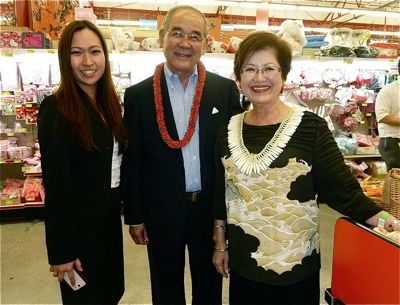
Marukai executive vice-president Richard Matsu with his wife Jo, right, and Kori Higa.
Matsu presented a check for $30,000 to representatives from four beneficiaries of the fundraising event: Japanese Cultural Center of Hawaii, Honolulu Japanese Chamber of Commerce, Honolulu Japanese Junior Chamber of Commerce, and the Hawaii United Okinawa Association.
Diners in line passed a sashimi boat, below, and ahi en route to sashimi plates.
Pan-seared, shichimi-scented mahimahi topped with cucumber crab salad, in a dashi-ginger nage, from 3660 on the Rise. Chef Russell Siu was also serving hoisin-glazed shortribs with jasmine rice.
An event goer shares her wishes with a sushi chef from Gokujo Sushi, which provided made-to-order nigiri and handroll sushi.
Nathan and Chika Tanaka of Candy Art Hawaii were there, demonstrating the traditional Japanese art of amezaiku, shaping hot melted sugar and starch syrup into whimsical lollipop shapes.
Labels:
ahi cutting,
sake,
sashimi,
Taste of Marukai
Location:
Marukai Wholesale Mart
Subscribe to:
Posts (Atom)