Tuesday, January 27, 2015

First bite: Gokoku Sushi at Koko Marina

Nadine Kam photos
Sashimi arrangement at the Dec. 9 grand opening of Gokoku Sushi.

Gokoku Sushi had a rough start, though at its grand opening Dec. 9, it held so much promise. I’d heard that people in the vicinity of the restaurant’s Koko Marina Center home were starved for sushi, but it turns out, not at the price of $20 for rolls and about $10.25 to $17 for appetizers.

Worst of all was the service of inexperienced high schoolers who milled about like extras on a movie set, roaming here and there without interacting with guests or doing anything constructive like bringing tea or refilling water glasses. I watched one boy set a table by making about 30 trips when perhaps four or five would have sufficed. It took him longer than most because he was grabbing one pair of chopsticks, laying it down, going back to the service area, grabbing another, and so on and so forth with tea cups, plates and napkins. Oy, and such a shame for a beautiful new restaurant.

The room is quite pretty, with a mix of traditional and contemporary flourishes.

After two visits there without improvement, I was about to give up and allow customers’ nature to take its course rather than take the fall for its demise. I’d heard the space the restaurant moved into is unlucky.

But then, I started hearing some good things. The service was getting better, and there is about a 50-50 reaction of positives to negatives about the food.

There have been other restaurants in town that have gone unreviewed by me while I wait for them to correct their problems. Here, there is hope. And that is crucial because the Japan-based Pierthirty Group—which owns about 200 restaurants in Japan and more in China—aims to open at least 30 restaurants in Hawaii over the next 10 years. All will have different themes, and the next to open may be an Italian restaurant, bakery and tempura shop, that will be part of the mix when the new Ala Moana Center additions are completed.

Let’s hope those get off to a better start.

Note: Photos are from a mix of grand opening and two more visits.


Scenes from the Dec. 9 grand opening celebration, including ahi-cutting demo.

From left, parent company Pierthirty president and CEO Akiyuki Takahashi, executive chef Katsuhisa Inoue, and vice-president Masayoshi Kurita.

Chawanmushi served at the restaurant’s grand opening was beautiful and special, served in eggshells with the flourish of gold leaf. Not on the menu though.

An ahi-cutting demonstration was also featured during the grand opening celebration.

Chicken and egg udon was a nice comfort dish.

There’s been a lot of inconsistency in presentation here, from lunch offerings to tempura. I felt cheated when my tempura was missing kabocha, while other plates had it.

Smoked salmon carpaccio is one of the evening appetizers, $16.50.

An ahi and salmon poke salad was nothing special, but I loved the accompanying salty/fiery wasabi sorbet.
Sushi rolls are pricey, but filling. The Dragon Roll is a California with shiso and layers of maguro, salmon and hamachi. I loved the heat and ctirus from the dollop of yuzukosho on top.

Tender chicken nanban with tartar sauce.

Misoyaki lamb wasn’t special enough to justify the $48 price tag.


Snapper sushi.

Japanese seafood stew can be described as a miso-based bouillabaisse.


Thursday, January 22, 2015

Foodland launches Eat Local Tuesdays

Nadine Kam photos
Aya Nishihara and Eric Newhouse have fun with props during the launch of Eat Local Tuesdays at Foodland Aina Haina.


Foodland launched its new weekly Eat Local Tuesdays program Jan. 20, with all Foodland Hawaii locations supporting the idea of buying local in support of farmers and a safe, sustainable food supply for Hawaii.

They will be making local products easier to find, tagging them with orange “locally grown” and “locally made” signs, and sharing samples from 3 to 6 p.m. or 4 to 7 p.m. depending on the store. Students from neighboring high schools will be offering free samples to customers, their participation made possible through a “Buy Local It Matters” Eat Local 2015 grant from the State Department of Agriculture.

They are also inviting customers to take the Eat Local Tuesdays pledge at checkout or online at Foodland.com, by committing to eat local at least one day a week.

Customers who take the pledge will receive double Maika’i points on the local items they purchase on Tuesdays. In addition, each week there will be a “Local Item of the Week” offered at a reduced price. You can also sign up to receive weekly notice of the Local Item of the Week, as well as recipes and information about the item and grower.

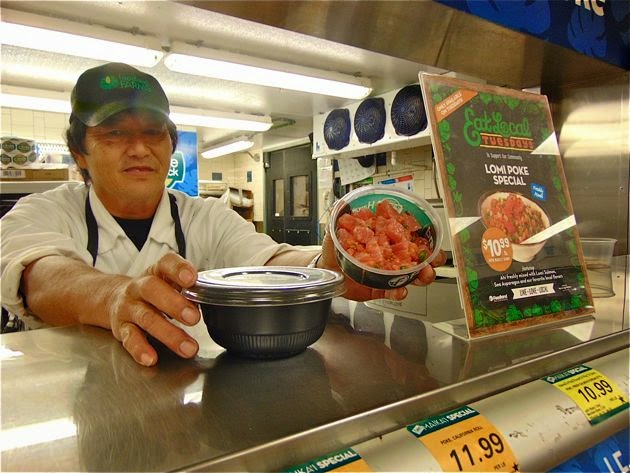
Also, on Tuesdays only, there will be a specially priced local deli offering and seafood poke offering. This week’s items were a Hawaiian plate lunch of laulau, hulihuli chicken, lomi salmon and pineapple, for $8.99, and a lomi poke bowl of ahi tossed with lomi salmon and sea asparagus, for $10.99.

For updates, follow @foodlandhi on Instagram and Twitter, and FoodlandHawaii on Facebook, and use the hashtag #EatLocalTuesdays

Kalani High School juniors Christina Shin, left, and Victoria Huynh were there to offer samples of meatloaf made with the Local Item of the Week, local ground beef, that this week was priced at $5.49 per pound with Maka’i Card.

Now here’s something I didn’t know, the River of Life Mission has its own chocolate-making enterprise, Chocolate on a Mission, to help raise funds for its support services. Learn more at chocolateonamission.com

Also offering chocolate was Amy Hammond of Aloha Chocolate Co., whose tins feature locally themed chocolates incorporating Waialua Estate Chocolate, and below, chocolate shaped like coffee beans.


More local sweets came in the form of macadamia nut and vanilla nougat made with local ingredients, shared by Christian Acerogiles. The roasted macadamia nuts were so pure and intense.

During the launch, Foodland Aina Haina welcomed a sizable neighbor island contingent of farmers and food producers, including beautiful Maui Fruit Jewels inspired by French patés de fruits, fresh fruit purees cooked with pectin to create a concentrated jammy jewel candy.

Stacy Au and Jan Tsue, left, came from the Big Island to represent Na’alehu’s Paradise Meadows Orchard and Bee Farm, whose products include Hawaii’s Local Buzz honey, macadamia nuts and coffee. Tsue told an amazing story of her aunt and uncle coming to Hawaii for peace and quiet, buying some land, and after clearing it, discovering they had a farm with lime and lemon trees, macadamia nuts and coffee.

A sampling of Paradise Meadows garlic roasted- and chocolate-covered macadamia nuts.

Kokohead Foods smoked ahi spread was the hit of the afternoon, a product of Kaimuki’s 12th Ave Grill.

Naked Cow Dairy’s Sabrina St. Martin was there to share new products, including honey- and Kona coffee-rubbed Kona Buzz cheese, and Pink Hawaii cheese studded with crushed pink peppercorns. Coming up will be a squid-ink brie.

Maui Pasta Co. offered crostini with artichoke heart dip, spinach linguini with tomato cream sauce and pesto lasagna.

Lomi poke was Tuesday’s seafood special, at $10.99 per pound with Maika’i Card.

This Hawaiian plate was the week’s local deli special.

Many of love the combination of sweet and spicy offered in Ohelo’s Four Pepper Jelly.

Foodland’s seafood salad was being served on beds of aquaponic lettuce from Mari’s Gardens.

Wednesday, January 21, 2015

An evening with Bruno Ménard at Halekulani's La Mer

Nadine Kam photos
Halekulani executive chef Vikram Garg and visiting chef Bruno Ménard share a laugh in the kitchen before service begins.

During a special dinner at Halekulani’s La Mer restaurant Sunday night, Chef Bruno Ménard gave diners a taste of the work of a three-star Michelin chef, one of the most prestigious designations in the culinary world.

In the kitchen before guests arrived, Ménard prepped the staff on the ins and outs of each dish and exacting details of service, including just a small pour of red wine and truffle Perigueux sauce that would accompany a filet of beef tenderloin prepared in the style of venison.

“And we should leave the extra sauce on the table?” one waiter asked hopefully, knowing that Hawaii diners love a good sauce.

A sharp “No!” was Ménard’s response, feeling the beef would stand on its own.

And so went the dinner, complex but spare, using the finest ingredients requested by the chef, with some local ingredients — such as Maui onions and Kona lobster — swapped for their French counterparts. Flavors were clear, clean and crisp, with dishes balanced throughout, every ingredient accounted for on the plate and nothing extraneous.

Each dish was paired with wine from Young’s Market Co., selected by Master Sommelier Patrick Okubo.

A beautiful sunset to start the evening.

Amuse of leek purée, tomato gelée and olive oil ice cream, with pickled tomato and pineapple. Essentially a beautiful light salad in a martini glass.

Kona lobster Parisienne blanketed by tomato-hibiscus gelée, with vanilla chutney and dots of crustacean oil. Topped with handpicked local vegetables. Accompanied by Louis Jadot, Corton-Charlemagne, Grand Cru 2012.

Delicate and billowy Maui onion soup over truffle custard royale studded with peas, fava beans and yuzu skin confit. Served with Charles Heidsieck, Blanc des Millénaires, Brut 1995.

Coquilles Saint Jacques Pôelées with Parmesan gnocchi, sake-scented cream, måche couilis and brown butter, served with Domaine Long-Depaquit, Chablis Vaudésir, Grand Cru 2009.

Beef tenderloin prepared venison-style, with savoy cabbage, light potato and foie gras cannelloni, and truffle and red wine Périgueux sauce. Topped with a line of salt, pepper and roasted soba tea. Accompanied by Château Rauzan-Segla, Margaux 2008 and Domaine du Clos Frantin, Vosne Romanée Les Malconsorts, 1er Cru 2012.

Valrhona P125 chocolate macaron soufflé with vanilla sorbet and caramelia pearls. Accompanied by Domaine La Tour Vielle, Banyuls Rimage 2013.

At the end of the meal, the chef asked me which was my favorite dish, which was hard to say. My first thought was of the lobster Parisienne layered over beautiful tomato and hibiscus gelée. But the Maui onion soup over truffle custard royale with textured surprises of fresh sweet peas, fava beans and yuzu skin confit hidden within, was heavenly. I couldn’t help but note the classic French dish is similar in concept to Japanese chawanmushi, which the chef might have also noted during his time at L’Osier in Tokyo, where he earned the Michelin stars.

I also loved the lightness of the non-pasta cabbage, potato, foie gras and black truffle canneloni.

At the end of the meal, many a guest, who had paid $295 per person, asked, “When’s the next dinner?”

The idea is planted, so time will tell.

Tuesday, January 13, 2015

'Buy local' matters to Hawaii's teen chefs

Nadine Kam photos
Krislyn Miyagawa, a Mid-Pac junior, won the Best Cookoff Performance award for her dish of seared opah and scallops over local veggies, during the statewide “Buy Local, It Matters” student recipe and cooking contest. Surrounding her are, from left, judges Pamela Young, Sheraton Waikiki chef Darren Demaya, Dean of the UHM College of Tropical Agriculture and Human Resources Maria Gallo, and Sharon Hurd from the Hawaii Department of Agriculture.

If you want evidence as to how far we’ve come on the culinary front, you just need to take a look at the professional level work presented by high school students who participated in the “Buy Local, It Matters” statewide recipe and cooking contest.

The event, sponsored by the Hawaii State Department of Agriculture, took place in the commercial kitchen at the University of Hawaii at Manoa Ag Science building Dec. 5, with five finalists hailing from Kea’au High on the Big Island, Molokai High, Campbell and Mid-Pac.

The students got there by first submitting a 200- to 300-word essay explaining what buying local meant to themselves, their family, community and Hawaii. They also had to submit a recipe that included at least two locally grown or produced food items. More than 65 students entered the contest.

Molokai High School senior Kiana Simmons works on her dish of round steak roulade with bacon, Kumu Farms pesto and Molokai sweet potato mash. She brought her homegrown products with her.

The state’s “Buy Local” campaign was launched in 2007. According to Gail Hurd from the Hawaii State Department of Agriculture, and one of the judges for the competition, sustainability education is important if we are to support local industry and produce. She said that although .4 percent of the state’s budget is dedicated to agriculture, Waikiki hotels buy 70 percent of local ingredients available “because tourists want that experience,” she said, while lamenting the loss of such local produce as yellow-skinned, pink-fesh guavas that once grew on Kauai but can no longer be found.

In getting the students to think about what we lose when we rely on imports, she said the importance of buying local goes back into their communities.

For the neighbor island students, agriculture is a subject close to home. Kea’au High School senior Kenny Nguyen’s father farms ginger and potatoes, and he’s well acquainted with Big Island grown Hamakua mushrooms and Kona blue shrimp that went into his siu mai.

Molokai high school senior Kiana Simmons also brought her own Molokai beef and sweet potatoes with her, rather than asking for Dept. of Ag assistance.

As to where they’re learning to cook and plate like a master chef, Mid-Pac junior Krislyn Miyagawa said she’s self-taught from watching YouTube videos for a year-and-a-half.

“I’m an active person and play tennis, so I’m into eating healthier and cooking healthier, so that was the spark for wanting to cook,” she said, adding that adults often warn, “If you don’t take care of your body now you’ll pay for it later.”

“I don’t eat out a lot because I’m able to cook by looking at pictures in magazines and videos on YouTube. I learn from them but make it my own.”

Mid-Pac junior Krislyn Miyagawa’s winning dish of seared opah and scallops over local veggies.

The two neighbor island contestants, Molokai High School senior Kiana Simmons and Kea’au senior Kenny Nguyen, shared the Best Winning Recipe award. Sheraton Waikiki chef Darren Demaya will be putting their dishes on the Kai Market menu.

Wednesday, January 7, 2015

First bite: Yakiniku House Futago

Nadine Kam photos
Niku sea urchin, on the menu at Yakiniku House Futago, combines beef, shiso, uni and nori.

We don’t need low expectations heading into 2015, so there’s nothing like starting the new year with a bang to set the tone for the rest of the year.

I’m grateful that Yakiniku House Futago came to town, with a perfectly timed opening on Christmas Day, a day of gifts and magic.

“Futago” is the Japanese word for “twins,” in reference to the chain’s youthful founders, Sunchol and Sunbong Lee. The pair launched their first Osaka-style yakiniku restaurant in Japan a mere four years ago. Today, their empire numbers 30 restaurants in Japan and China. Next up: Manhattan.

The New York restaurant was already in the works when the duo decided to open in Hawaii after vacationing here and discovering a lack of Japanese-style yakiniku venues. They found only Hiroshi, in Waikiki, and Gyu-kaku, and thought the market would be perfect for their concept, presenting premium beef in a lively setting with plenty of coddling from an energetic — if not all English-speaking — young staff.

Explaining through an interpreter, Sunbong — who will be working the floor alongside his staff for about a month — summed up their work as “eatertainment,” with the idea that hands-on “concierge” grill service, music and the palpable enthusiasm of waiters enhances the flavor of the food.

He may have a point there, but I’ve always felt that as a truth seeker, I’m impervious to the kind of bells and whistles restaurateurs use to charm a crowd. The food is darn good on its own, and my taste buds don’t change with the addition of good service and lavish decor.

But having someone there to guide the experience and offer helpful information makes dinner here all the more impressive, especially for those more likely to swallow than taste food. When pointed out, you will find vast differences in sections of beef, a mere one-half inch apart.

At 949 Kapahulu Ave. Call (808) 734-3956.

Welcome to their world:

Though Korean by blood, twins Sunbong, left, and Sunchol Lee grew up in Japan favoring the lighter Japanese, rather than highly marinated Korean-style yakiniku.

The niku sea urchin, with the beef cooked, ready to be rolled up and devoured.

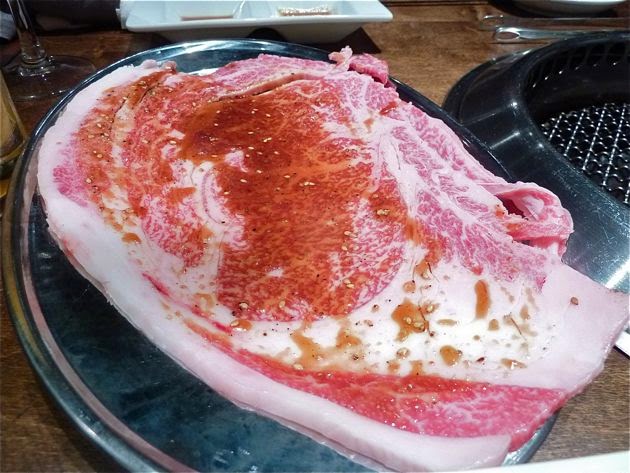
It’s rare to experience a vertical beef tasting, but that is what you get with the house specialty, Japanese Wagyu “Hamideru” Kalbi ($28). Your “concierge” will cuts away parts and pre­sents them one at a time for you to savor and compare the fatty marbled rib shi, tender and sweet rib maki, a triangular slipper-shaped piece they call the “geta,” and “kaduri,” the piece of back fat that tastes like short ribs. This can be enjoyed with Kyushu-style ponzu sauce, but don’t add sauce until you have savored the wagyu solo, with its sweetness and fattiness.”

Hamideru availability is limited. Your next-best choice might be the Futago Premium selection of four kinds of beef ($25 per person), about four ounces each of beef tongue, short rib, flank and skirt steak, grilled tableside for you.

The garlic steak isn’t as flavorful as the other cuts, but worth a try, for the compensation, a garlic-butter-shiso-sesame sauce warmed on the grill.

Beyond the meat options, there is an assortment of kim chee ($4.80), and below, avocado ($8.80) served two ways, with a creamy dressing and a mix of shoyu and wasabi.

Raw beef is mixed with a small dice of apple and topped with raw egg in the Korean specialty of yukhoe, available with rice ($9.80), or without ($12.80), as an appetizer.

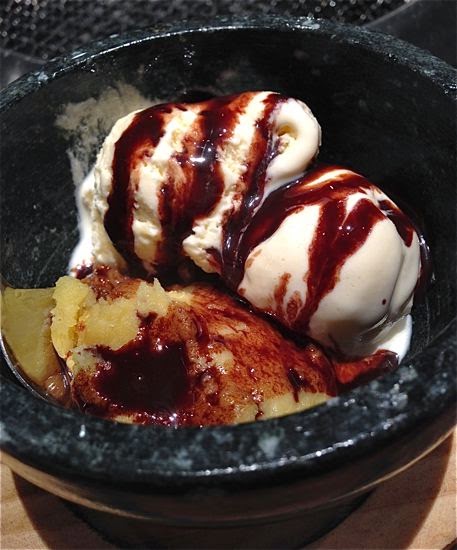
Dessert of sweet potato ($4.80) served with vanilla ice cream and a drizzle of chocolate syrup proved to be a wonderful combination.