Showing posts with label tea. Show all posts

Monday, July 25, 2016

Tea Drops simplifies art of tea

Tea Drops photo
Tea Drops provide a convenient, portable way for tea lovers to enjoy a their favorite beverage whereever they go. In the cup is a tumeric tea drop. They come in a variety of shapes and flavors.

I love tea, but I'm also lazy, and that's a problem. Because, good tea requires a lot of implements, whether it's a bamboo whisk for your matcha powder or infuser for leaf teas. Then there's cleanup. There are a lot of times I'll pass in favor of an easy sugar-saturated juice instead.

Sashee Chandran also found it difficult to enjoy a fresh pot of tea while working in an office. But, unlike me, she was determined to do something about it, because tea is in her blood. She grew up steeped in tea culture east and west. Her mother is Chinese, and her father is Sri Lankan, raised in the British tea tradition.

"I realized how difficult it is for people to make tea, but there are a lot of people who would drink tea if the process could be simplified, so I spent 2-1/2 years experimenting in my kitchen," said Chandran, who was in town to share her creation at the Hawaii Lodging, Hospitality & Food Service Expo that took place July 13 and 14 at the Blaisdell Center.

Nadine Kam photos
Sashee Chandran spent two-and-a-half years perfecting her recipes in her kitchen.

The result is Tea Drops, organic teas and spices ground fine compressed into a variety of shapes, that can simply be dropped into a cup of hot water any place, any time. The drop dissolves in hot water, and voilá, hot (or cold) tea in flavors such as Cardamom Spice, Chocolate Earl Grey, and Citrus Ginger, all with a touch of organic sugar. (Sugar-free options are coming in fall.)

I have to say I was confused when someone gave me a couple of drops with no instructions. I placed it in my cup, expecting it to dissolve into loose leaves. When it just disappeared, I was like, "What is this?" It all came clear when I was able to sit down with Chandran—how else?—Over cups of tea.

Although tea fanatics in Hawaii prefer their teas sugar-free, Chandran said she loves chai and the British tradition of adding milk to any tea, so her first impulse was to recreate that combination of sweetened milk tea spiced with cardamom, cinnamon and cloves.

"I'm the last person who should have been experimenting in the kitchen. I have no chemistry background, no food service background, but I did know how to make a good cup of tea because I've been drinking it all my life. The hardest part was finding the right proportion of tea vs. spices and organic cane sugar to make it balanced."

Tea Drops come in paper or reusable and gift ready wood boxes. When done, the boxes can be upcycled in myriad ways, including finding a second life as a desktop or windowsill planter for your cacti garden.

She made the first batches just for herself, which she dropped into cups of hot water while working at eBay. Co-workers who witnessed it started asking, "What's that?" Pretty soon, they wanted them for themselves and Chandran was in business. With her background in ecommerce, she launched an online shop and within a couple of months was able to leave her full-time job.

Tea has now become part of her philosophy toward promoting a happy, healthy and sustainable lifestyle. Tea Drops all-in-one recipes eliminate the need for teabags and sweetener packets. The boxes are 100 percent biodegradable and compostable. Paulownia wood boxes can be repurposed for storage or used as planters.

She has also been experimenting with adding tea drops to cookies, soups, and making tea-infused soaps.

"I feel like this is the right time for it. People are into organic, they're into tumeric and matcha. There's something for everyone. Each tea has its own medicinal properties."

Turmeric, for example, has been used for centuries to treat wounds and infections. Modern science has shown that its main ingredient, curcumin, has antibiotic and antioxidant properties. According to WebMD, other chemicals in turmeric are anti-inflammatory, considered beneficial for overall health.

Her teas are now available in 200 small boutiques across the nation, including Nic's Island Cafe in Kukui Plaza. They are offered in single-flavor boxes at $16.50 for 10 drops, or a giftable wood box that can be customized with eight drops, for $18. It has been a popular seller during holidays, for both individuals and corporate gift givers looking for something new that also happens to be thoughtful, healthful, time-saving and beautiful.
———————————
Look for Tea Drops at Nic's Island Cafe at 50 S. Beretania St. Call 200-7416. Or visit myteadrop.com.


Tea Drops photo
Ground tea leaves are compressed into different shapes, in just the right amount to create an 8-ounce cup of tea when water is added. The heart shape represents Sweet Peppermint.

Thursday, February 26, 2015

Neiman Marcus introduces Pacific Tea Garden curated artisanal teas

Nadine Kam photos
The Chinese New Year season marked the debut of the Neiman Marcus Tea Collection by The Pacific Tea Garden.

The Pacific Place Tea Garden on the fourth floor of Ala Moana Center was always a pleasant oasis for tea and sweets or sandwiches and other beverages and shave ice, before becoming a casualty of the center’s expansion plans.

But owner Lynette Jee, known around town as The Tea Lady, has been hard at work on other projects, including a new curated selection of artisan teas for former neighbor Neiman Marcus.

The Neiman Marcus Tea Collection by The Pacific Tea Garden made its debut during a Lunar New Year tea tasting that took place Feb. 20 in NM’s Mermaid Bar. Tins sell for $14 for Lychee Black Tea or Chai, to $24 for Superior Green Oolong.

Samples of teas and fruit tisanes were passed around the room to allow us to breathe in their fragrance before steeping.

Tisane with coconut gau and li see envelope containing chocolate.

On the evening’s tasting menu were four of the teas, alongside New Year’s gau and other treats.

First up for sipping was the sweet, elegant “Pink Ginger Forest,” fruit-and-vegetable tisane comprising passionfruit, beets, organic bamboo, pineapple and lemon.

Jee demonstrated the gong fu ritual of using a gaiwan, or lidded tea cup, for making tea, and passed around samples that allowed comparison between the aromas of the dry teas and the scent of the steeped tea inside the emptied gaiwan.

She also passed around a brick of Yunnan Pu-erh, an earthy, incense-like three-year-aged reddish-brown tea associated with good health because of its antioxidant content. It takes work prying the leaves from the brick, so we sampled the loose-leaf version.

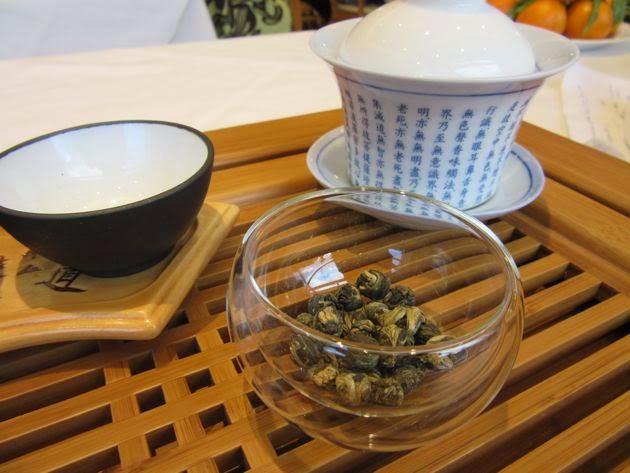
The third tea was the popular Dragon Phoenix Jasmine Pearls from Fujian. Each leaf is rolled into an orb the size of pearls, resulting in intense fragrance released with the pearl’s blossoming in hot water. There were many requests for seconds.

Superior Green Oolong from Fu Shou Shan, Taiwan, offered a mellow finish, representative of spring harvest leaves with floral notes.

In addition to the traditional Chinese teas, the collection also features Darjeeling, Earl Grey, English Breakfast teas and a handful inspired by Hawaii, including Queen Emma Rose, Summer Palace and Mango Hawaii.

There is also a teabag selection that includes flavors of Mango Hawaii, Pineapple Plantation, Rainbow Hawaii and PassionBerry Iced Tea.

For more about the traditional Chinese tea ritual, here’s a link to one of my earlier posts from a trip to Shanghai: http://takeabite.staradvertiserblogs.com/2012/05/01/opening-the-senses-to-jin-xuans-tea-experience

Pu-erh tea is often sold in brick form. The compressed tea leaves almost resemble the cloud patterns in Asian art.

Jasmine pearls open and release their perfume while steeping.

Timed for the Chinese, or Lunar New Year, symbols of long life, luck and wealth filled The Mermaid Bar, including narcissus plants, and below, oranges.


———
Nadine Kam is Style Editor and staff restaurant critic at the Honolulu Star-Advertiser; her coverage is in print on Wednesdays and Thursdays. Contact her via email at nkam@staradvertiser.com and follow her on Twitter, Instagram and Rebel Mouse.

Wednesday, May 25, 2011

Yielding to chef brings surprise and pleasure

Nadine Kam photos
Diners at Nanzan GiroGiro sit around the cooking station where kaiseki meals are prepared, the menu set by the chef. In the foreground are the implements of tea including the powdered matcha served at the meal's end.

By Nadine Kam
nkam@staradvertiser.com

Control freaks beware. To enter Nanzan GiroGiro is to surrender to the chef and the moment.

There is no food menu to peruse. In fact, the staff would rather not share the menu, lest it spoil the surprise that accompanies any dramatic production. So, it's just as well that my visit to the kaiseki restaurant comes at the end of the month, just as the restaurant is about to unveil June's seasonal menu.

I've often spoken of dining as live theater, and Nanzan GiroGiro takes this concept to new heights. The meal starts with set "show times" with first seatings at 6 or 6:30 p.m. and second seating at 8 or 8:30 p.m. The time you choose depends on whether you're the eat-and-run type or whether you like hanging around over drinks after a meal. Staffers have stayed in place till 2 a.m. to accommodate the latter group.

There is a drink menu listing a range of sake, shochu, wine, soft drinks and teas. Once you've chosen, sit back and enjoy the performance.


Diners are seated around a large cooking and service station, so you can watch the prep when you're not wholly absorbed in the dish before you. There's precedent for this style of seating in the teppanyaki style popularized by Benihana, as well as the open-kitchen phenomenon that started in the late 1980s. But diners have rarely relinquished so much control of their meal. When I was there, one man asked for ginger to go with his ahi poke. Alas, with the kaiseki, the chef's exacting preparation, presentation and promise is that each dish is perfect as is. To veer from the chef's vision with a dash of condiments here and there would be insulting. So the man was told, in a gentle way, there was no ginger available.

Nanzan GiroGiro marks a partnership between a restaurant company and Kyoto-based ceramist. All the dishware is the work of the artist Nanzan, and a small gallery in the restaurant pays homage to his family's ceramic tradition. Many of the sake cups and dishes feature the little man, "ikan jin," or man of leisure, hanging onto the rims as a reminder to relax and hang out for a while.

Those familiar with the work of the Urasenke Foundation here might know that its home base is in Kyoto, where the ceramic tradition grew alongside Urasenke's practice of chanoyu, or the way of tea.

The ceremonial aspects of chanoyu are evident in Nanzan GiroGiro's kaiseki, which brings chanoyu's Zen principles and focus to the meal. It is the chef's task, as an artist, to express through his work the essence of the ingredients and dishes presented, and the task of diners to immerse themselves in the experience, toward fully acknowledging, understanding and appreciating the meal set before them. It's a tall order for those accustomed to talking through a meal and wolfing down food without a moment's hesitation or meditation.

Many of the sake cups and dishes are decorated with a ceramic "ikan jin," or man of leisure, created by the Kyoto-based ceramist Nanzan, a partner in the restaurant.


May's $50 seven-course meal started with vivid green chanwanmushi topped with a dollop of uni and shimmering brown gelee of bonito with a dot of wasabi for heat.

Next up was shredded sesame chicken presented in a small, palm-size lacquered seashell with side offerings of yellow squash, smelt in a green bean sauce and miso-chirashi sushi. Kaiseki and prix fixe meals tend to be a boon to restaurants because of small portions. Here, for example, I calculated that the entire room of about 36 was probably fed with only four chicken breasts. But the value of art can't be measured in the cost of raw materials.


The next dish was a relaxing bowl of a single piece of monchong in ginger broth. Thin strings of daikon and baby bok choi added to the dish. Each flavor was so distinct, one could easily taste the small dot of ume floated on top of the dish.


Ahi poke received a makeover with the next course. The ahi was presented plain with a side dipping sauce of shoyu with mountain potato, green onion, radish sprouts, slivered daikon and asparagus slices. When poured and mixed with the ahi, the potato, daikon and asparagus brought a delightful crunch to a usually entirely squishy dish. It was quite wonderful.


An entree of braised beef, pork and lotus root patty was one of the most substantial dishes but also my least favorite. It was engulfed with clam broth and flavorless yuba, or soy bean paper.

The next dish made up for it — delicious smoky grilled eggplant gelee in a crunchy sauce of pulverized dried shrimp of the sort used frequently in Chinese cooking, topped with okra. This was my favorite dish, so much so, I devoured it before I could take a photo.


Closing the meal was a simple dish of uku, or gray snapper, chazuke with nori and pearls of micro arare. On the side was a delicious kinpira of slivered beets, and tsukemono with small squares of konbu that had been marinated in soy sauce and sake and pressed.


For those who need more drama at the end of the meal, dessert is an $8 add-on. May's offering was mound of lilikoi souffle accompanied by a petite almond macaron.

A finale of powdered matcha green tea sent early diners out the door on a happy note.

Ceramics on display.
———
Nadine Kam's restaurant reviews are conducted anonymously and paid for by the Star-Advertiser.