Nadine Kam photos
Kyushu is known for its hot springs and Beppu shiitake that contains potassium to help lower blood pressure, vitamin D to prevent osteoporosis and bowel cancer, lentinan used in Japan as an anti-tumor medicine, and eritadenine to lower blood cholesterol and help prevent arteriosclerosis.
The Hawaii Restaurant Association welcomed "The 5th Japanese Food Trade Fair" to the Japanese Cultural Center of Honolulu on March 24, showcasing products various companies want to introduce to the local market.
The event, geared toward retailers, wholesalers and restaurants, included more than 100 products by 20 Japan vendors. I'm hoping to see some of them on store shelves in months to come, such as delicate warabi mochi from Kyoto; plum-accented furikake, and vegetable furikake that can be folded into omelettes as well as sprinkled over rice; yogurt-and-strawberry, cream cheese and other wonderful flavors of mochi; and packaged spicy tuna to speed sushi-making at home.
The event was presented with support of the Japan External Trade Organization, and included a mochi tsuki demonstration and sushi-making demonstration.
A second, public "Sunshine Market" will take place March 26 at J-Shop, during which consumers will be able to purchase the products from 10 a.m. until they are sold out. The J-Shop grocery store is at 1513 Young St.
Local boy Travis Miyamoto now works for Hidecho Suisan Co., in Uwajima City, and taught their cooks how to make poke out of the company's fish, including samples of hamachi and tai that he was serving up.
To speed food prep, silver salmon from Aichi prefecture is marinated in mirin lees and miso and packaged. At home, just grill and eat.
The packaged and finished salmon.
One of the most intriguing products is an all-natural liquid that allows caterers or food preparers to freeze sushi and preserve it for a year. Without freezing, use of the preservative will allow sushi to sit for two hours without refrigeration. The quality, when thawed, he said, would be comparable to grocery store sushi.
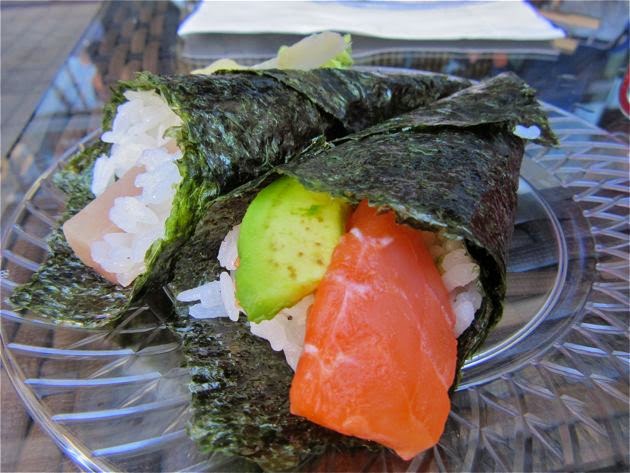
Sushi made from packaged spicy tuna and salmon.
Popso extra virgin olive oil is spiced with sansho pepper and contains natural rock salt comprising seven to 10 minerals. It contains no trans-fatty acid and no cholesterol. In the background is the spiced oil and popcorn shrimp sautéed in the oil.
Furikake with dehydrated vegetables and the red of plum.
Fresh mochi was made on the spot, starting with the pounding of the rice, shaping and dredging in kinako.
This cheese manju was delicate and delicious.
A guide to flavored mochi ranging from chocolate to custard cream cheese.
—————
Nadine Kam is Style Editor and staff restaurant critic at the Honolulu Star-Advertiser; her coverage is in print on Wednesdays and Thursdays. Contact her via email at nkam@staradvertiser.com and follow her on Twitter, Instagram and Rebel Mouse.
Showing posts with label Japanese food. Show all posts
Friday, March 25, 2016
Tuesday, March 31, 2015
Golden Pork Ton-kotsu Ramen Bar newest ramen hotspot
Nadine Kam photos
Meet your new obsession, the Golden Pork Classic ramen at Golden Pork Ton-kotsu Ramen Bar.
IKKA Dining International, the Hawaii subsidiary of Japan-based IKKA Dining Project, opened Golden Pork Ton-kotsu Ramen Bar with the intention of offering the best ramen in Honolulu, and I think they’ve struck gold with their Golden Pork classic Kyushu-style ramen.
This is the one foodies I know have been craving since their first taste of the collagen-thickened pork bone broth. Spicy and garlic versions also have their merits to the point where, until you find your favorite, you will be caught up in a vicious cycle of desire. If you order the classic, you will long for the spicy. If you order the spicy, you will long for garlic, etc., etc. As much as I like them all, I appreciate the unadorned purity of the classic.
The funny thing is that while the classic elicits many a “Wow!” and “OMG!” moment from local ramen enthusiasts, friends from Japan say people from the Motherland would not be as excited because all this is standard over there. If this raises standards here, so much the better.
The space formerly occupied by Mediterraneo has been fully transformed.
A moonscape featuring Mount Fuji was created in tile on one side of the room.
Of course the broth, created by extracting marrow, minerals and collagen from pork bones over four hours, is only half the equation. The other half is the noodle, and chef Masahiro Endo spent a year going back and forth with Sun Noodle to perfect the thin, straight noodle exclusive to Golden Pork. It is so fine and so much like ramen noodles from Japan that I was surprised it was made by Sun, which I associate with a bouncier, chewier noodle. This breakthrough is very impressive.
Golden Pork was set to be open straight through from 11:30 a.m. to 11 p.m. daily, but word spread quickly during the soft opening period. When the restaurant officially opened its doors March 29, they ended up having to close early after running out of broth by 8:30 p.m.
Beyond the three ramen and three tsukemen specialties, there are salads and side dishes. For something new, try the “Monja” salad, a variation of the Tokyo street-style monjayaki, or crisp veggie pancake. Shredded cabbage and crisp fried noodles are tossed together with corn, bonito flakes and a light dusting of yellow curry. My full review appears in the April 1 issue of the Star-Advertiser.
Golden Pork Ton-kotsu Ramen Bar is at 1279 S. King St. Call 888-5358. Until further notice, hours are 11:30 a.m. to 3 p.m. for lunch, and 5 to 11 p.m. for dinner with last call for food 30 minutes prior to closing. Also, while the restaurant awaits its liquor license, patrons are invited to BYOB with no corkage fee.
A D.I.Y. Caesar salad allows you to mix in as much or as little of the soft-boiled egg as you want (it’s hidden under all that Parmesan).
Golden Pork buns are juicy and topped with a teriyaki glaze and sweet aioli with mustard; currently $3.50 each.
Spicy red miso dragon ramen with shichimi tonkotsu broth.
Wednesday, March 11, 2015
Shokudo giving away $10,000 for 10th anniversary
Nadine Kam photos
Ordering Shokudo’s anniversary maple-bacon honey toast this month could make you $1,000 richer.
Shokudo Japanese Restaurant & Bar celebrated 10 years in Hawaii with a media party on its Kapiolani Boulevard open-air patio on March 10.
Wine and Kirin frozen foam beer flowed, while guests nibbled on pupu including roast pork, potstickers, fried rice and arabiki sausages, ordered hand-rolled sushi, and sampled the month’s anniversary special of maple-bacon honey toast.
It’s a three-tier monster of a dessert which, playing off Willy Wonka, could be your golden ticket toward winning $1,000. Each order of the maple-bacon honey toast—$19.95 and available for purchase with any food item—will come with a gold envelope containing a prize ranging from a $10 discount coupon for your next visit to the restaurant, to one of 10 $1,000 cash prizes. Other prizes include surfboards and golf clubs.
The restaurant will be rolling out new menu items next month, and will also be unveiling its sister restaurant next door, in the former Angelo Pietro space. I’m looking forward to trying its tapas and Italian fare.
—————
Shokudo Japanese Restaurant & Bar is in the Ala Moana Pacific Center, 1585 Kapiolani Boulevard. Call 941-3701.
Kirin frozen foam beer was in demand.
Shokudo is marking its 10th anniversary, and will soon debut a new menu, as well as a sister restaurant next door, specializing in tapas and Italian fare.
Hamachi, and salmon and avocado, were among handroll sushi options.
Plenty of soybeans served as pupu.
Crunchy arabiki sausage isn’t on Shokudo’s current recipe, but it should be!
The honey toast aftermath. Four people only managed to polish off 1-1/2 layers of the three-tiered dessert.
———
Nadine Kam is Style Editor and staff restaurant critic at the Honolulu Star-Advertiser; her coverage is in print on Wednesdays and Thursdays. Contact her via email at nkam@staradvertiser.com and follow her on Twitter, Instagram and Rebel Mouse.
Ordering Shokudo’s anniversary maple-bacon honey toast this month could make you $1,000 richer.
Shokudo Japanese Restaurant & Bar celebrated 10 years in Hawaii with a media party on its Kapiolani Boulevard open-air patio on March 10.
Wine and Kirin frozen foam beer flowed, while guests nibbled on pupu including roast pork, potstickers, fried rice and arabiki sausages, ordered hand-rolled sushi, and sampled the month’s anniversary special of maple-bacon honey toast.
It’s a three-tier monster of a dessert which, playing off Willy Wonka, could be your golden ticket toward winning $1,000. Each order of the maple-bacon honey toast—$19.95 and available for purchase with any food item—will come with a gold envelope containing a prize ranging from a $10 discount coupon for your next visit to the restaurant, to one of 10 $1,000 cash prizes. Other prizes include surfboards and golf clubs.
The restaurant will be rolling out new menu items next month, and will also be unveiling its sister restaurant next door, in the former Angelo Pietro space. I’m looking forward to trying its tapas and Italian fare.
—————
Shokudo Japanese Restaurant & Bar is in the Ala Moana Pacific Center, 1585 Kapiolani Boulevard. Call 941-3701.
Kirin frozen foam beer was in demand.
Shokudo is marking its 10th anniversary, and will soon debut a new menu, as well as a sister restaurant next door, specializing in tapas and Italian fare.
Hamachi, and salmon and avocado, were among handroll sushi options.
Plenty of soybeans served as pupu.
Crunchy arabiki sausage isn’t on Shokudo’s current recipe, but it should be!
The honey toast aftermath. Four people only managed to polish off 1-1/2 layers of the three-tiered dessert.
———
Nadine Kam is Style Editor and staff restaurant critic at the Honolulu Star-Advertiser; her coverage is in print on Wednesdays and Thursdays. Contact her via email at nkam@staradvertiser.com and follow her on Twitter, Instagram and Rebel Mouse.
Wednesday, May 25, 2011
Yielding to chef brings surprise and pleasure

Diners at Nanzan GiroGiro sit around the cooking station where kaiseki meals are prepared, the menu set by the chef. In the foreground are the implements of tea including the powdered matcha served at the meal's end.
By Nadine Kam
nkam@staradvertiser.com
Control freaks beware. To enter Nanzan GiroGiro is to surrender to the chef and the moment.
There is no food menu to peruse. In fact, the staff would rather not share the menu, lest it spoil the surprise that accompanies any dramatic production. So, it's just as well that my visit to the kaiseki restaurant comes at the end of the month, just as the restaurant is about to unveil June's seasonal menu.
I've often spoken of dining as live theater, and Nanzan GiroGiro takes this concept to new heights. The meal starts with set "show times" with first seatings at 6 or 6:30 p.m. and second seating at 8 or 8:30 p.m. The time you choose depends on whether you're the eat-and-run type or whether you like hanging around over drinks after a meal. Staffers have stayed in place till 2 a.m. to accommodate the latter group.
There is a drink menu listing a range of sake, shochu, wine, soft drinks and teas. Once you've chosen, sit back and enjoy the performance.
Diners are seated around a large cooking and service station, so you can watch the prep when you're not wholly absorbed in the dish before you. There's precedent for this style of seating in the teppanyaki style popularized by Benihana, as well as the open-kitchen phenomenon that started in the late 1980s. But diners have rarely relinquished so much control of their meal. When I was there, one man asked for ginger to go with his ahi poke. Alas, with the kaiseki, the chef's exacting preparation, presentation and promise is that each dish is perfect as is. To veer from the chef's vision with a dash of condiments here and there would be insulting. So the man was told, in a gentle way, there was no ginger available.Nanzan GiroGiro marks a partnership between a restaurant company and Kyoto-based ceramist. All the dishware is the work of the artist Nanzan, and a small gallery in the restaurant pays homage to his family's ceramic tradition. Many of the sake cups and dishes feature the little man, "ikan jin," or man of leisure, hanging onto the rims as a reminder to relax and hang out for a while.
Those familiar with the work of the Urasenke Foundation here might know that its home base is in Kyoto, where the ceramic tradition grew alongside Urasenke's practice of chanoyu, or the way of tea.
The ceremonial aspects of chanoyu are evident in Nanzan GiroGiro's kaiseki, which brings chanoyu's Zen principles and focus to the meal. It is the chef's task, as an artist, to express through his work the essence of the ingredients and dishes presented, and the task of diners to immerse themselves in the experience, toward fully acknowledging, understanding and appreciating the meal set before them. It's a tall order for those accustomed to talking through a meal and wolfing down food without a moment's hesitation or meditation.

May's $50 seven-course meal started with vivid green chanwanmushi topped with a dollop of uni and shimmering brown gelee of bonito with a dot of wasabi for heat.
Next up was shredded sesame chicken presented in a small, palm-size lacquered seashell with side offerings of yellow squash, smelt in a green bean sauce and miso-chirashi sushi. Kaiseki and prix fixe meals tend to be a boon to restaurants because of small portions. Here, for example, I calculated that the entire room of about 36 was probably fed with only four chicken breasts. But the value of art can't be measured in the cost of raw materials.
The next dish was a relaxing bowl of a single piece of monchong in ginger broth. Thin strings of daikon and baby bok choi added to the dish. Each flavor was so distinct, one could easily taste the small dot of ume floated on top of the dish.
Ahi poke received a makeover with the next course. The ahi was presented plain with a side dipping sauce of shoyu with mountain potato, green onion, radish sprouts, slivered daikon and asparagus slices. When poured and mixed with the ahi, the potato, daikon and asparagus brought a delightful crunch to a usually entirely squishy dish. It was quite wonderful.
An entree of braised beef, pork and lotus root patty was one of the most substantial dishes but also my least favorite. It was engulfed with clam broth and flavorless yuba, or soy bean paper.
The next dish made up for it — delicious smoky grilled eggplant gelee in a crunchy sauce of pulverized dried shrimp of the sort used frequently in Chinese cooking, topped with okra. This was my favorite dish, so much so, I devoured it before I could take a photo.
Closing the meal was a simple dish of uku, or gray snapper, chazuke with nori and pearls of micro arare. On the side was a delicious kinpira of slivered beets, and tsukemono with small squares of konbu that had been marinated in soy sauce and sake and pressed.
For those who need more drama at the end of the meal, dessert is an $8 add-on. May's offering was mound of lilikoi souffle accompanied by a petite almond macaron.
A finale of powdered matcha green tea sent early diners out the door on a happy note.
Ceramics on display.
———
Nadine Kam's restaurant reviews are conducted anonymously and paid for by the Star-Advertiser.
Wednesday, February 2, 2011
Izakaya Heaven
Shinn's impressive menu is both delicious and perfect for any budget
By Nadine Kam
In December, when the pace of restaurant openings was picking up, I got an e-mail from one of my restaurant faithfuls, who said he saw a new Japanese restaurant called Shinn and was going to check it out and report back to me.
Then, I never heard from him.
No matter, there's been no shortage of newcomers. Now that I've been to Shinn, I know why he didn't get back to me. Da buggah! If I were him, I wouldn't tell me either. Why spoil a new favorite restaurant — and that's what it is — by making it impossible to get into?
The new izakaya is as contemporary as they come. I love the way Japanese restaurants, no matter how sleek, always manage to introduce a sense of nature. Here, it's achieved through walls embedded with river rock, an earthy, textured accent to an otherwise stark palette of blacks and grays.
If it were not so popular, you would have a choice of four seating areas to suit your mood. There are traditional western-style tables, plus a robata bar, sushi bar and tatami area. Early birds can reserve a spot, but once the room fills, you'll have to go where the seats open, though the smoke-averse may not want to sit near the robata bar, where the grill is in constant demand.
The flow of people can seem overwhelming at the door, and Shinn could do a better job communicating with guests about when they might be seated. Workers can also be slow to take names and clear tables. Once you're seated, flow is good, but communication can be sketchy when certain dishes run out. You can be nursing a craving for a dish that never arrives, and it's only when you ask your waiter that he discovers the last (maybe yours) was just sent to another table.
SUSHI IZAKAYA SHINN2065 S. Beretania St.» 946-7466
Cost: $40 to $50 for two without alcohol Ratings compare similar restaurants: ![]() ![]() ![]() - excellent![]() ![]() - very good; exceeds expectations![]() - average - below average. |
Or, you could enjoy a bowl of oden in a smoky broth, filling it with various fishcake such as chikuwa, hanpen or gobo-filled gobouten, octopus, potato and konnyaku, all sold by the piece, at $1.50 to $2.50 per item. It was the first time I'd tried kinkyakumochi ($2.50), an elegant tofu pouch filled with soft mochi, oozing out like melted cheese.
If money is tight, a warm bowl of oden and a couple of robata will send you on your merry way for about $15, but who can stop there, knowing there are plenty of sushi and kitchen specialties as well?
Beyond the regular menu you're handed a list of about 30 daily specialties. Don't faint if you see $36 bluefin fatty tuna sashimi. There are plenty of good things to eat for much less, such as hot starters of clams steamed in sake ($8.25) and kurobuta kakuni ($7.50), which made me think of Morimoto's and how this much smaller restaurant has managed to beat the giant in delivering the magic combination of both style and substance. Where Morimoto's pork was heavy and lethargic, here, it is a delicate, melt-on-the-tongue marvel.
Earthenware dishes in hues of brown, sienna, green and ochre present a warm environment that highlights the freshness and naturalness of the ingredients used. I appreciate the kitchen's lighthandedness throughout, allowing the food to speak for itself without the interjections of human ego.
Cold starters include the requisite ahi poke ($16) and beef tataki salad ($12). You'll also see Botan shrimp with yuzu gelee ($13.50), but you might also go straight for the hamachi yuzukoshou ($14) prepared the same way, dotted with a tart, salty yuzu sauce. Pure heaven! It's served with vegetables, ogo and onion, but I'd stay away from the latter overpowering ingredient because the fish and sauce should be enjoyed in their most elemental state.
Later, when I tried to order hamachi nigiri, I was disappointed to find the kitchen had run out of the fish. In fact, if you show up late — that is, by 8 p.m. on a Saturday night, just before the restaurant's one day of closure — it may have run out of lot of things. Gone when I visited: fish collars, Berkshire pork sausages and jumbo shrimp for robata. I was also tempted by the thought of grilled smelt but was told it's no longer on the menu.
After the hamachi ran out, Kona kampachi was offered as a substitute, to which I readily agreed. But as much as I like the local fish, there's no comparison.
Two recent specials that seemed popular enough to merit a place on the daily menu are grilled moi ($17) and a bowl of udon topped with thin slices of duck breast ($6). The dissected, flattened moi is not very pretty to look at, but delicious. The udon is not the bouncy variety that dominates the market here. Its soft texture makes it ideal for kids, which also makes it popular with parents. Speaking of which, Shinn has been drawing a diverse audience that wouldn't quite mix anywhere else: families, cool kids, foodies, couples, businessmen and old folks. Maybe that speaks to the comfort level Shinn offers, or maybe the food is worth giving integration a try. Imagine what this food could do for world peace.
All these goodies distracted me from the fish mainstays of the menu. Nigiri sushi is available by the piece at $3 to $7. You can get small rolls as well, about six slender pieces for $4 to $8. I tried the salmon avocado roll ($5) as an option to the more common California roll ($7) but discovered why salmon isn't usually used when the heavy salt flavor overwhelmed the avocado. Otherwise, I had more interest in the cooked menu than the raw.
For dessert, there's the no-miss, refreshing almond tofu ($5.50), topped with cubes of plum wine jelly and granita of frozen strawberries. Frozen berries warmed with a pour of grenadine are another option ($6.50).
Now, try to stay out of my way.
Nadine Kam's restaurant reviews are conducted anonymously and paid for by the Star-Advertiser.
E-mail nkam@staradvertiser.com.
Subscribe to:
Posts (Atom)