Nadine Kam photos Dan dan noodles at Fortune Noodle showcase the full potency of the Sichuan pepper (hidden in the sauced at the bottom) that helps makes Sichuan cuisine so distinctive. It is definitely an acquired taste.
BY NADINE KAM
We did not have a true Sichuan restaurant until the arrival of Fortune Noodle at the new 808 Center at 808 Sheridan St.
The small, casual restaurant is the first Hawaii branch of a Chinese-based restaurant chain. It specializes in a short, fast menu of noodle soups, grilled meat and meat-and-vegetable sautes.
Dan dan noodles (below) are the star of the menu, at $6.99 for a small bowl. It will be an eye-opener for those who think they know dan dan noodles. This is the authentic version in which a sauce of chili oil, garlic and crushed Sichuan peppercorns lies at the bottom of the bowl, topped with noodles, ground beef and green onions. Mix it all together to get the full impact, which is not as much hot as mouth-numbing, thanks to the “peppercorn,” which is not really a pepper but the dried husks of coriander seeds. Its herbal character is similar to lavender.
Chili oil dumplings with a dab of garlic paste are a winner for those who can handle a little bit of heat.
Though the dish is delicious, thanks to garlic and real peppers, the numbing factor and the soapy herbal taste is off-putting. It made me want to reach for something to rinse out my mouth. That didn’t stop me from going back for more. On the second trip I left the sauce at the bottom of the bowl and dipped the noodles in only as much sauce as I could tolerate.
Warm up to the peppers with red chili oil dumplings ($6.99). Then cool off with a dessert of iced “noodle” ($2.99), plant gelatin molded in its bowl and topped with brown sugar and a strawberry purée. It looks odd, but it’s so worth ordering.
This restaurant is really worth a full review, but alas, space in the newspaper is limited and with so many eateries opening in the new 808 Center, it would appear too repetitive to keep showing up at this spot week after week for my formal reviews. I’ll be back at the center soon enough anyway, likely as soon as next week! ————— Fortune Noodle is at 808 Sheridan St. Call 349-3711.
Don’t attempt the boiled beef in hot chili sauce ($29.99) unless you’re acclimated to the Sichuan pepper in the smaller dan dan noodle bowl. All those red chilis are no problem to me, but the herbal-flavored Sichuan peppercorns in the dish cause an uncomfortable numbing sensation.
I loved the sweet delicacy of the Chef's Special Oxtail.
An assortment of skewered meat and vegetables. I only had the shrimp, at left, which were delicious.
Mapo tofu with rice. Given that mapo tofu abounds locally, I'd try other items before ordering this again. It's $10.99 with rice.
Marinated fried pork is one of my favorite dishes here, accompanied by a house togarashi-like chili pepper blend for dipping or sprinkling over the pork. It’s delicious with or without the heat.
Sauteed beans for balancing the meat and noodle items.
Dessert is not very pretty but it’s very refreshing. Plant gelatin forms a glob of a “noodle” topped with brown sugar and a pour of strawberry purée. I was skeptical but ended up loving it.
————— Nadine Kam is Style Editor and staff restaurant critic at the Honolulu Star-Advertiser; her coverage is in print on Wednesdays and Thursdays. Contact her via email at nkam@staradvertiser.com and follow her on Twitter, Instagram and Rebel Mouse.
Nadine Kam photos Dried fish at Gwangjang Market, one of the oldest traditional marketplaces in Seoul, South Korea.
BY NADINE KAM
SEOUL, SOUTH KOREA — Gwangjang Market, which started in 1905, is one of the oldest and largest traditional markets in South Korea, packing in more than 5,000 shops and food stalls. You’ll feel exactly like one of the food stall sardines as you shuffle your way through crowds of 65,000 people said by Wikipedia to visit the market each day.
In addition to tourists wanting absorb the sights, sounds and smells, it’s a place where locals gather for a quick lunchtime bite or pau hana drinks and pupu while sitting shoulder to shoulder with friends and strangers alike.
It’s a great place to sample Korean street food, as hundreds of vendors cook up tteokbokki or toppoki, blood sausage, mandoo, roast pork and chili crab. The market is best known for its bindaetteok, sizzling griddle pancakes made with mung bean batter, meat and vegetables. On a hot day, the mix of greasy air and overcrowding can be overwhelming, and I happened to be visiting in the middle of summer, but these are said to be a treat on a rainy or cold winter’s day.
Stirring the rice cake tteokbokki, simplified in the west as toppoki.
If you tire of the food and the crowds, head upstairs which is home to a fabric mart and home goods shops. There, tailors are waiting to create garments for you, including the traditional Korean hanbok; the most beautiful run about $400. The market is a huge source of Korean bridal apparel, and a few days after visiting the market I was lucky to chance upon a wedding party at Korea House, where the Western groom and his bride were outfitted in the colorful traditional costumes.
Gwangjang Market is at 6-1 Yeji-dong, Jongno-gu, and can be reached via subway line 1 to Jongno-gu station (exit 8), or line 2 to Eujiro station. Shops are generally open 10 a.m. to 6 p.m. Mondays to Saturdays; food stalls are open daily until about 10 p.m. Hours vary by vendor.
Here are some of the market offerings:
An abundance of chili crab.
Chop chae for a crowd.
Seeing plenty of red at a stall specializing in marinated seafood.
Marinated blue crab with chili peppers and garlic.
Nadine Kam photos A vendor showcases octopus and other seafood at Jagalchi Fish Market in Busan, South Korea.
BY NADINE KAM
BUSAN, SOUTH KOREA — A visit to Busan is not complete without a stop at Jagalchi Fish Market, the largest fish market in Korea.
Getting there the quickest way possible from Seoul involves a two-hour ride via KTX, or Korea Train eXpress bullet train, that zips along at about 190 miles per hour.
Situated at Nampo Port, the market began taking shape in the late 19th century. During the Korean War, it became key to survival for many women whose husbands went off to fight. Women still command many of the outdoor stalls at the fish market, and are known as Jagalchi ajumma, a reference to middle-aged, married or street vendor status. It might also be considered the Korean equivalent of “auntie” as used here in Hawaii when referring to non-relatives of a certain age.
Here, you can find a range of live sea creatures, filleted fish and dried seafood. There are a lot of sea creatures I’d never seen firsthand, giving it a sort of ersatz aquarium status for travelers who welcome the colorful sights but have no intention of eating eels, sea squirts or penile-looking gaebul or spoon worms.
And it’s not too often we get a chance to study living flounders, trying to fathom how they evolved to be so flat with their two eyes perched so close together on the top of their heads.
It all just makes the seafood offerings available in Hawaii seem quite limited and tame.
It’s hard to linger long though, particularly outdoors where the odoriferous scents can be overwhelming. I took that as a cue to break for lunch at the buffet restaurant above the market.
Palm-sized geoducks at Jaglachi Fish Market.
To save you from making a mess at home, vendors will gut and clean your fish for you.
Fish available whole or ready to be filleted.
Inside Jagalchi Fish Market in Busan, South Korea, tanks dubbed “fish hotels” keep fish and shellfish alive for those who want a guarantee of freshness.
Just outside the market, leisure fishermen try their luck in the waters of Nampo Port.
Not everything looks appetizing.
Shrimp and shellfish.
There is a huge buffet restaurant above the fish market, overlooking the harbor. All-you-can-eat options include sushi and other seafood, fried anchovies, dim sum, barbecue chicken and pastas. These multi-color pork sausages were all different, flavored with seasonings from chilies (red) to a dash of curry (yellow).
Here’s something you don’t see in local buffets but de rigueur in Korea, a stack of roasted garlic. ————— Nadine Kam is Style Editor and staff restaurant critic at the Honolulu Star-Advertiser; her coverage is in print on Wednesdays and Thursdays. Contact her via email at nkam@staradvertiser.com and follow her on Twitter, Instagram and Rebel Mouse.
Nadine Kam photos Patrons flock to the bar at Liholiho Yacht Club where a portrait of chef Ravi Kapur’s mom, circa 1975, is a beacon of warmth and aloha.
BY NADINE KAM
SAN FRANCISCO — One of San Francisco’s hottest restaurants brings a taste of Hawaii to the menu.
In a city where dining can seem overly precious — at Sons and Daughters we were privy to the source of every item on our plate, just shy of knowing the name of the bantam that laid the egg on our plate — Liholiho Yacht Club’s big plates, massive portions is a bold and perhaps long-due step in the opposite direction.
This is no delicate flower of a restaurant. It’s sort of Pacific Rim on steroids. Just as Spam our way is gaining buzz across the nation, LYC chef and co-owner Ravi Kapur finds himself in the right place at the right time with offerings such as housemade Spam fried rice and an Ohana Table for bringing family and friends together for a no-brainer evening. Just tell them how many in your party, and they’ll prepare 10 to 12 shareable dishes at $55 per person, with a minimum $440 booking.
Bon Appetit magazine recently featured Kapur in a Spam roundup, and the chef was also made the cover of the summer 2015 edition of Edible San Francisco magazine.
Kapur’s cred hails from having grown up on Oahu, then working at San Francisco’s Boulevard and Prospect restaurants before launching his popular LYC popup events in 2012. His Nob Hill bricks and mortar location became a reality with the help of Allyson Jossel and Jeff Hanak of Nopa.
You can sense the Hawaii connection at the door, where floor tiles spell “aloha” in blue against a white backdrop and staffers look like people you saw every day in high school. Enhancing the bar area is a black-and-white portrait of a young, beautiful, smiling wahine, who turns out to be Kapur’s mom, circa 1975. The warmth is palpable and no doubt feels like safe haven for those seeking a break from snob rule.
It’s a pleasant place to hang out, so it’s packed every night. For me, the best seats in the house are toward the back of the room with an overview of the open kitchen where the multi-cultural alchemy happens. Like most chefs in Hawaii, Kapur draws from his chop suey experience, growing up eating Asian, Southeast Asian, Hawaiian, Indian and Portuguese cuisine. Those influences have made their way into his plates in a way that will look familiar to anyone with roots in the isles.
Having ordered a lot of the heavier dishes, my one regret was passing on the Spam fried rice. I mistakenly imagined this to be like typical island fried rice, with the Spam chopped into an itty bitty mince. Only after we left did I do an Instagram search of the restaurant’s offerings and came across the attention-grabbing large slabs of Kapur’s housemade spam over rice that looked so delish. I’m pretty sure that if this restaurant were transplanted here, people would be lining up for this.
It’s wonderful to see the flavors we love connecting with people beyond our shores thanks to transplants like Kapur and in New York, Noreetuh’s Chung Chow. And the vicarious spotlight on Hawaii’s food culture is bound to spill over closer to home.
So the next time you’re in the city, Liholiho Yacht Club is at 871 Sutter St. Open 5 to 10:30 p.m. Mondays to Thursdays, and 5 to 11 p.m. Fridays and Saturdays. Call (415) 440-5446.
Here are the dishes sampled:
An appetizer of poke ($15.50) with sesame oil and radish served over nori crackers.
Duck liver toast ($9.75) topped with jalapeño and pickled pineapple. I’d never seen this combination before, but savory-meets-sweet is perfect chemistry.
We couldn’t resist trying one of the specials of the day, a salmon tail made to serve three to four. The salmon tail swimming in a pool of red chili sauce and smothered with black bean-sauced green beans was a strange vision, but it was so delicious, and worth raving about and sharing snaps for days to come.
A country roast ($28.75) was too dry for my liking.
Twice-cooked pork belly ($29.50) with pineapple, thai basil, fennel and a hint of char siu flavor.
Stuff dreams are made of: a dish of shortribs with escargot-filled bone marrow, mushrooms, spring onions and horseradish ($36).
For dessert, Baked Hawaii caramelized pineapple ice cream ($10) is Kapur’s 50th state nod to Baked Alaska. The ice cream is encased in beehive-shape meringue and torched before it arrives at the table, lighting up eyes in the process.
>>>>><<<<<
Lastly, before leaving San Francisco, I leave you with one more quickie dessert option, this time at Smitten Ice Cream near the Rockridge BART station in Oakland. At Smitten, liquid nitrogen provides a minus 321 degrees Fahrenheit chill to freeze your ice cream on the spot. It’s 90 seconds from placing your order to heaven.
Non-flash video ————— Nadine Kam is Style Editor and staff restaurant critic at the Honolulu Star-Advertiser; her coverage is in print on Wednesdays and Thursdays. Contact her via email at nkam@staradvertiser.com and follow her on Twitter, Instagram and Rebel Mouse.
Nadine Kam photos A map at the center of The Shed in Healdsburg, Calif., shows the birthplace of produce and products carried at the marketplace.
BY NADINE KAM
CALIFORNIA — California’s wine country is paradise for nouveau frontiersman and homesteaders who have at their fingertips the riches of the land. Their markets are the envy of all who cook, bake and craft. Here’s a peek inside two of them:
THE SHED
25 North St., Healdsburg. Call (707) 431-7433.
healdsburgshed.com (Note: When I checked, the site worked on Firefox browser, but not Safari.)
The Shed was created as a celebration of farming and the pleasure of real food. It’s a beautiful space, part food market, part housewares celebrating the kitchen and D.I.Y. ethos, and part cafe with a fermentation bar for sampling house made kombucha, keffir water or shrubs, old-fashioned drinking vinegars that have made a comeback. Also on offer, area wines and beers, hard cider, honey mead and natural sodas.
After shopping, stay for a bite in the cafe, featuring such delectables as a frittata of zucchini, onion and fontina; roast pork meatballs with cinnamon vinegar, nectarine and poppy seeds; and cilantro-cured cod. Breakfast and weekend brunch is also offered.
Open 8 a.m. to 9 p.m. daily except Tuesdays.
Produce at The Shed.
Knitters will know the name of the sheep who produced their wool. These skeins are from Lambert, Cupcake or Punch.
After ogling the beautiful produce, including these green and purple tomatillos and eggplants, you can get a bite to eat in The Shed’s Cafe Coffee and Fermentation Bar.
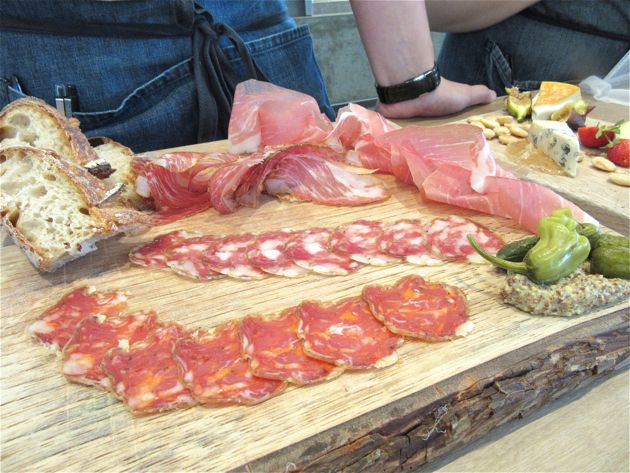
A salumi board offered in The Shed Cafe recently featured prosciutto, salumi and coppa.
A Shed cheese platter with bread, strawberries and Marcona almonds.
This pizza with fontina, jalapeños and roasted figs was fantastic.
>>>>><<<<<
Oxbow Public Market photo Oxbow Public Market houses 22 vendors offering artisan edibles.
Oxbow Public Market
610 and 644 First St., Napa. Call (707) 226-6529.
Visit oxbowpublicmarket.com.
Part of the market includes the rehabilitation of a 1930s tire store and garage, remodeled to accommodate 22 independent merchants within a 40,000 square-foot indoor marketplace featuring local and regional artisan edibles.
Products offered include local organic produce, artisan cheese, spices, chocolate, olive oil, baked goods and desserts, wine and spirits, and housewares.
If you get hungry following a drive from San Francisco or surrounding areas, restaurants on site include Kitchen Door, Hog Island Oyster Bar, Three Twins Ice Cream, Gott’s Roadside, Ca’ Momi enoteca, and The Fatted Calf.
Open 7:30 a.m. to 9:30 p.m. Note, some vendors may open between 9 a.m. and 7 p.m. Visit the website for specifics.
Some of the cheese selections at Oxbow Cheese & Wine Merchant.
Shrubs, drinking vinegars infused with fruit juice, are big throughout the region. These are from Napastäk.
A selection of spices from Whole Spice.
Bitters for sampling at the Napa Valley Distllery Tasting Salon within Oxbow Public Market.
Above and below, beef any way you want it.
Manila clam steamers and crispy anchovies from Hog Island Oyster Co., and below, the namesake shellfish on a platter.
————— Nadine Kam is Style Editor and staff restaurant critic at the Honolulu Star-Advertiser; her coverage is in print on Wednesdays and Thursdays. Contact her via email at nkam@staradvertiser.com and follow her on Twitter, Instagram and Rebel Mouse.